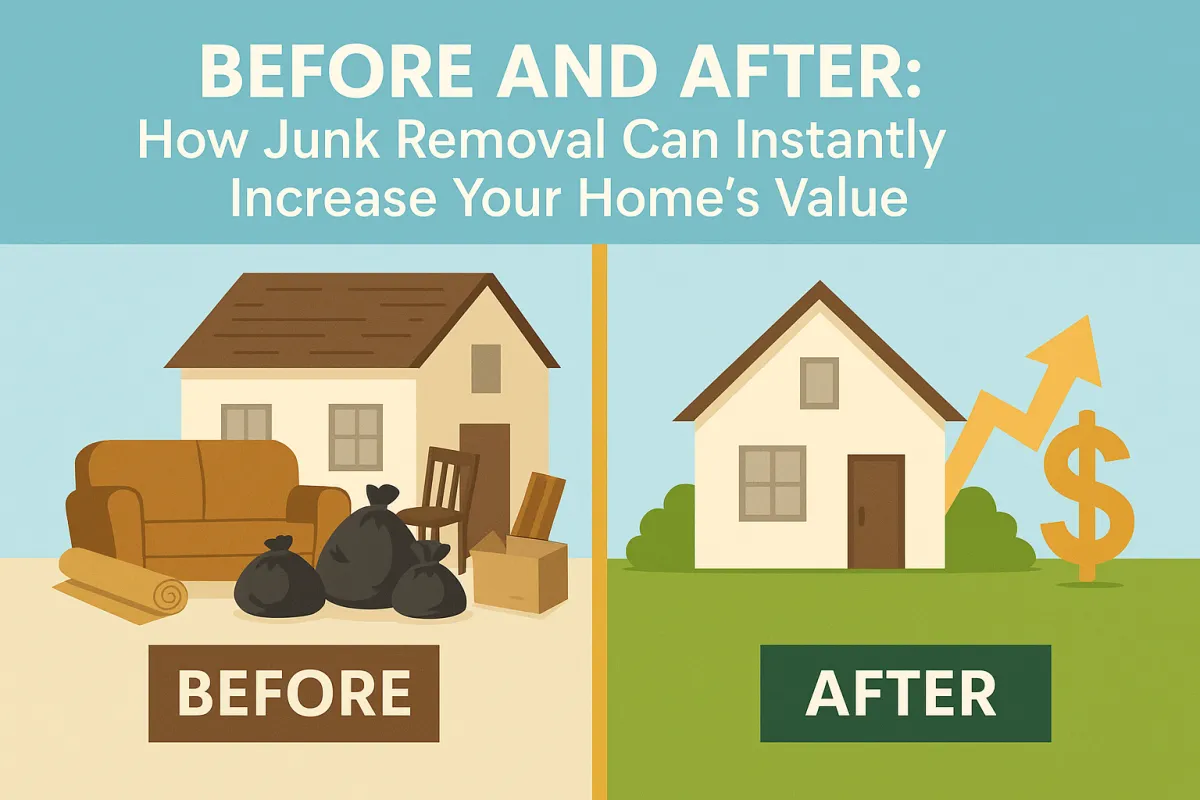
Before and After: How Junk Removal Can Instantly Increase Your Home's Value
The Victoria real estate agent walked through the Fairfield heritage home and winced. Beautiful hardwood floors, covered in boxes. Spacious rooms, crammed with furniture. Stunning ocean-view windows—blocked by clutter. The homeowners wanted $950,000. The agent knew it would appraise at $820,000 in current condition.
Three days later, after professional junk removal transformed the space, the same agent returned. The home now showcased its true character. Rooms felt 30% larger. Natural light flooded through previously obscured windows. The carefully curated remaining furniture highlighted period details instead of hiding them.
New listing price: $975,000. Sold in 11 days for $988,000.
Research on home staging impact shows that 82% of buyers' agents said staging made it easier for buyers to visualize the property as their future home. But before staging comes something even more fundamental: removing what doesn't belong. For Greater Victoria homeowners, professional junk removal isn't an expense—it's an investment with immediate, measurable returns.
The Psychology of Space: Why Clutter Costs You
How Buyers Process Visual Information
The 7-second rule:
Buyers form first impressions within 7 seconds of entering
Visual clutter triggers "too small" perception
Disorganization suggests deferred maintenance
Personal items prevent buyer visualization
According to real estate psychology research, clutter makes spaces appear smaller and less valuable—even when square footage is identical to organized homes.
Oak Bay market example: Two similar 1,200 sq ft homes listed simultaneously. Cluttered home sat 89 days, sold for $687,000. Decluttered home sold in 12 days for $745,000—a $58,000 difference attributable primarily to presentation.
The "Hidden Square Footage" Phenomenon
Perceived vs. actual space:
Clutter's visual impact:
Rooms appear 20-30% smaller when cluttered
Pathways feel cramped even when wide
Ceilings seem lower with visual chaos
Natural light can't reach or reflect properly
Saanich appraisal insight: Professional appraisers consistently value cluttered homes 8-15% lower than identical organized homes, citing "functional obsolescence" and "deferred maintenance perception."
The transformation equation:
$800 professional junk removal × Greater Victoria median home price ($875,000) × 10% perceived value increase = $87,500 potential value gain
ROI: 10,838%
Room-by-Room Value Impact
Living Room: The Make-or-Break Space
Before junk removal:
❌ Oversized furniture blocking flow
❌ Entertainment centers from the 1990s
❌ Exercise equipment "temporarily" stored
❌ Boxes of unidentified items
❌ Excessive personal decor and collections
After professional cleanout:
✅ Furniture scaled to room size
✅ Clear pathways showcasing layout
✅ Modern, minimal aesthetic
✅ Natural light maximized
✅ Architectural features highlighted
Value impact: Living rooms are the primary showing space. Real estate experts note that decluttered living areas can increase perceived home value by 5-10%.
Langford example: 1,400 sq ft home with cluttered living room received $650,000 offers. After professional removal and staging, identical offers jumped to $695,000—$45,000 increase for less than $1,000 investment.
Kitchen: Where Deals Die
The kitchen value multiplier:
Why kitchens matter disproportionately:
Most scrutinized room during showings
Buyers spend longest time here
Clutter suggests insufficient storage
Disorganization implies poor maintenance
Common kitchen value killers:
Counters covered in small appliances
Refrigerator exteriors buried in magnets/papers
Overflowing cupboards visible during showings
Pantries packed to bursting
Broken or duplicate items taking space
The transformation:
Clear counters (appliances in cabinets)
Organized cabinets (50% visible space)
Minimal refrigerator decor
Streamlined pantry
Esquimalt case study: Kitchen declutter revealed premium granite counters previously hidden under clutter. Appraisal increased $18,000 based primarily on "improved perceived kitchen quality."
Bedrooms: Creating Buyer Dreams
Master bedroom impact:
Clutter's bedroom effects:
Overcrowded closets suggest insufficient storage
Excess furniture makes rooms feel cramped
Personal items prevent buyer imagination
Exercise equipment implies "no other space available"
Professional decluttering reveals:
True room dimensions
Closet capacity (critical selling point)
Natural light and views
Peaceful sanctuary potential
According to staging professionals, bedrooms should feel 30% empty to allow buyers to envision their belongings—impossible when filled with current owner's excess.
Victoria West bedroom transformation: Removing excess furniture and closet overflow increased perceived closet size by 40%, directly addressing buyer's #1 concern. Home sold $32,000 over asking.
Bathrooms: Small Spaces, Big Impact
Why bathroom clutter matters:
Visual perception in confined spaces:
Clutter more noticeable in small areas
Counter items imply insufficient storage
Personal products uncomfortable for viewers
Disorganization magnified in tight quarters
The minimalist bathroom advantage:
Appears larger and more luxurious
Suggests recent updates/good maintenance
Allows focus on fixtures and finishes
Creates spa-like impression
Colwood townhome: Bathroom declutter (removing 90% of visible items) contributed to $15,000 appraisal increase—disproportionate impact from 40 sq ft space.
Garage and Basement: The Hidden Value Spaces
Why buyers scrutinize storage areas:
Storage space evaluation:
Cluttered storage suggests home lacks adequate space
Disorganized areas imply systemic problems
Full garages prevent vehicle storage visualization
Basement clutter obscures structural condition
Professional cleanout reveals:
True storage capacity
Structural integrity (walls, floors, foundation)
Potential for future finishing/development
Actual vehicle capacity in garages
Oak Bay estate: Basement cleanout revealed 800 sq ft of usable space previously invisible under decades of accumulation. Home appraised $95,000 higher when basement square footage could be properly measured and evaluated.
The Appraisal Impact: Hard Numbers
How Appraisers Evaluate Cluttered Homes
Appraisal adjustment factors:
Physical condition assessment:
Assumed deferred maintenance
Inability to verify systems/structure
Conservative estimates when visibility limited
Functional utility evaluation:
Cluttered spaces rated as "poor utility"
Storage areas assessed as "at capacity"
Rooms evaluated at minimum size when cluttered
Flow and livability scored lower
Market appeal scoring:
Comparable homes comparison disadvantaged
Appeal to typical buyer reduced
Marketing time estimated longer
Price adjustments downward
Saanich appraiser quote: "I routinely adjust cluttered homes down 5-12% compared to similar organized properties. I can't assess what I can't see, so I assume the worst."
Real Victoria Appraisal Comparisons
Case Study 1: Fairfield Character Home
Before junk removal:
Listed price: $875,000
Appraisal: $795,000 ("cluttered, difficult to assess true condition")
Adjustment factors: -$45,000 (condition), -$35,000 (appeal)
After professional cleanout:
New appraisal: $890,000
Adjustment factors: +$25,000 (superior condition presentation)
Net value increase: $95,000
Investment: $1,200 professional junk removal + $800 minor staging = $2,000 Return: $95,000 (4,750% ROI)
Case Study 2: Langford Family Home
Before decluttering:
3 bed, 2 bath, 1,600 sq ft
Appraisal: $685,000
Notes: "cluttered, storage appears inadequate, small room sizes"
After comprehensive cleanout:
Same square footage, now visible
New appraisal: $735,000
Notes: "well-maintained, adequate storage, spacious"
Value increase: $50,000
The Competitive Market Advantage
Days on Market: The Hidden Cost of Clutter
Victoria market timing matters:
Cluttered home trajectory:
Average days on market: 65-90 days
Price reductions: 2-3 (averaging 8% total)
Buyer perception: "stale listing, must be problems"
Carrying costs: Mortgage, utilities, maintenance
Decluttered home trajectory:
Average days on market: 12-25 days
Price reductions: 0-1 (averaging 2% if any)
Buyer perception: "desirable, must act quickly"
Minimal carrying costs
Financial impact of extended listing:
75 extra days × $3,500 monthly carrying costs = $8,750
Emotional stress and life disruption: Priceless
Research shows that properly prepared homes sell 50% faster than cluttered comparables—and faster sales mean higher prices in competitive markets.
Multiple Offer Scenarios
Why decluttered homes attract competition:
Buyer psychology in clean spaces:
Easy visualization as future home
Perceived move-in ready condition
Fewer negotiation concerns
Emotional attachment forms quickly
Esquimalt bidding war: Decluttered home received 7 offers within 4 days, selling $67,000 over asking. Agent confirmed decluttering was decisive factor in competitive interest.
Comparison: Cluttered comparable in same neighborhood sat 43 days, eventually selling $22,000 under asking after two price reductions.
The Cost-Benefit Analysis
Professional Junk Removal Investment
Typical Greater Victoria costs:
Service pricing:
Studio/1 bedroom cleanout: $300-500
2-3 bedroom home: $600-1,200
Larger homes/estates: $1,500-3,500
Garage/basement only: $400-800
Additional value-add services:
Donation coordination (tax receipts)
Recycling documentation
Deep cleaning post-removal
Organization consultation
Staging Cost Comparison
Professional staging costs:
Full staging: $2,000-5,000
Partial staging: $800-2,000
Monthly rental fees: $500-1,200
The junk removal advantage: Professional cleanout costs 40-70% less than staging, yet often produces 60-80% of staging's value impact.
Strategic approach: Junk removal first, then targeted staging only if needed—maximizing ROI on both investments.
DIY vs. Professional: The Hidden Costs
DIY decluttering challenges:
Time investment:
Average homeowner: 40-80 hours
Emotional decision fatigue
Family conflicts over items
Never quite "done enough"
Opportunity costs:
Weeks/months of delayed listing
Lost optimal selling season
Foregone higher offers
Extended carrying costs
Professional efficiency:
Complete cleanout: 4-8 hours
Objective decision support
Immediate listing readiness
Proper disposal (donation/recycling)
Colwood seller testimonial: "We spent 3 weekends trying to declutter ourselves and barely made a dent. Rai Junk Removal finished in 5 hours—and our realtor said it was the difference between $780K and $825K."
Strategic Timing: When to Remove Junk
Pre-Listing Preparation Timeline
8 weeks before listing:
Comprehensive home assessment
Identify all excess/unnecessary items
Research comparable home presentations
Budget for professional services
6 weeks before listing:
Complete comprehensive cleanout
Deep clean newly revealed spaces
Address any revealed maintenance issues
4 weeks before listing:
Evaluate staging needs
Professional photography preparation
Final touch-ups and minor repairs
Optimize remaining furniture placement
2 weeks before listing:
Final cleaning and preparation
Professional photography session
Listing materials finalized
Ready to launch
Market Timing Considerations
Victoria's peak selling seasons:
Spring market (March-May):
Highest buyer activity
Premium prices achieved
Prepare homes in January-February
Declutter during winter for spring advantage
Summer market (June-August):
Strong continued activity
Family buyers timing school years
Prepare in April-May
Less competition than spring
Fall market (September-October):
Motivated buyers before holidays
Less inventory competition
Prepare in July-August
Avoid November-December slowdown
Winter opportunity (November-February):
Serious buyers only
Less competition
Prepare year-round for any opportunity
Quicker response capability
Maximizing Return on Junk Removal
What to Remove for Maximum Impact
High-priority removals:
Universal value killers:
✅ Excess furniture (especially oversized pieces)
✅ Personal collections and memorabilia
✅ Worn or dated items
✅ Broken or non-functional pieces
✅ Anything preventing room function demonstration
Storage space clearance:
✅ 50-70% closet emptying
✅ Garage/basement 70-80% clearance
✅ Kitchen cabinet/pantry 40% clearance
✅ Bathroom counter complete clearing
Outdoor impact items:
✅ Yard waste and debris
✅ Broken or unused equipment
✅ Excess garden materials
✅ Old outdoor furniture
What to Keep for Staging Value
Strategic retention:
High-value furniture:
Quality pieces that showcase space
Appropriately scaled to room dimensions
Neutral, timeless styles
Items demonstrating room function
Emotional connection pieces:
Artwork (neutral, professional)
Plants (healthy, well-maintained)
Lighting (modern, attractive)
Textiles (clean, neutral, minimal)
The Environmental and Social Benefits
Beyond Personal Gain
Community impact of responsible removal:
Donation economy:
Usable items to Habitat ReStore Victoria
Furniture to transition houses
Household goods to thrift stores
Tax receipts supporting charitable deductions
Recycling benefits:
Metal, wood, plastic recovery
E-waste proper processing
Construction material repurposing
Landfill diversion (60-80% typical)
Feel-good factor: Selling your Victoria home while supporting community organizations and environmental sustainability.
Frequently Asked Questions
Q: Will junk removal really increase my home's value?
A: Yes—appraisers consistently value decluttered homes 8-15% higher than cluttered comparables. Even conservative 5% increase on Victoria's median home price ($875,000) equals $43,750 value gain.
Q: How much should I remove before listing?
A: General rule: Remove 30-50% of furniture and 50-70% of closet contents. Spaces should feel 30-40% empty to allow buyer visualization.
Q: Should I remove junk before or after the appraisal?
A: BEFORE—appraisals directly impact listing price and buyer perception. Don't limit your value with preventable clutter.
Q: What if I think buyers should see the home "as lived in"?
A: Buyers don't want to see YOUR life—they want to envision THEIR life. Research consistently shows that decluttered, staged homes sell faster and for more money.
Q: Can I just put things in the basement/garage instead of removing them?
A: No—buyers scrutinize storage spaces carefully. Stuffed storage suggests inadequate capacity and deferred maintenance problems.
Q: Is professional junk removal tax deductible?
A: Generally no, but donation receipts from items removed ARE deductible, potentially offsetting service costs.
Take Action: Your Home's Hidden Value Awaits
Every day your Victoria home sits cluttered is a day it's worth thousands less than it could be. Those boxes aren't just taking up space—they're stealing equity you've built over years of ownership.
The transformation takes hours. The value increase lasts through closing.
Ready to unlock your home's true market value? Contact Rai Junk Removal for pre-listing cleanouts designed specifically for Greater Victoria real estate market demands. Serving Victoria, Langford, Saanich, Colwood, and Esquimalt with realtor-approved services that maximize home presentation.
Schedule your value-boosting cleanout today and discover how much equity clutter has been hiding.
Your home is worth more than it appears. Let's prove it.
